
reflections on mbiti: producing time in the sasa
in response to my love from an email sent on the premature changing of the seasons in this year of 2025 - observations from an august walk with views of a purple-leafed, partly shedding tree.

though leaves turn amber,
time passes not so quickly:
it still must be made
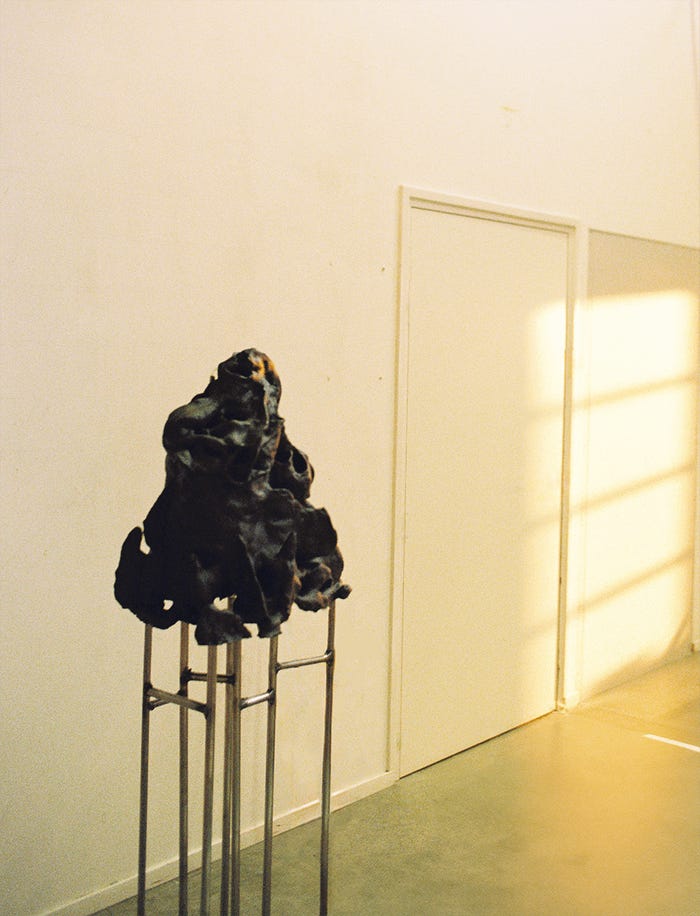
artwork from ronny kinuthia: a scultural interpretation of mbitis’s philosophy.
around the time that you sent this email, i'd watched a video touching on similar themes of which you speak: the passage of time, and the language we use to talk about it. it was on tik tok (classic) from the creator @colourfulradio, and it was about kenyan philosopher john mbiti's perception of time as moving backwards rather than forwards. in his 1969 book, "african religions and philosophy," mbiti defines time as a "two-dimensional phenomenon, with a long past, vibrant present, and virtually no future." "sasa" describes "the now, the recent past, and the immediate future"; "zamani" is the vast endless past where all events eventually go on to live forever" (colourfulradio, 2025). because time is composed by events, "time has to be experienced in order to make sense or to become real" (mbiti, 1969). therefore, we as people can and must create or produce as much time as we need or want.
bringing this into our observations of the earlier changing of the seasons this year, mbiti also looked at the changing of the seasons as a measure of time, with a year only being complete when its four seasons have passed. so, if we spend time lounging around and (outwardly) doing nothing in the "sasa," we're either waiting for time or producing time. after which an event has taken place, it goes into the "zamani," where the event can never be tangibly touched or experienced again - much like how the majority of our far future events in western conceptualisation, or branches of our fig trees (as per ms sylvia plath), can/will never be experienced. in this view, when me or you daydream about future houses we'll live in together, or if one (me) were to plan for a whole host of imagined future worries and strifes, because those events are so beyond the tangible scope of what's occurring now or even imminently, they can't even be considered a part of time.
similarly, in terms of the dead, even they remain in "sasa" while at the stage of being talk about, remembered, discussed by family members, before inevitably going into "zamani" when nobody still living carries their memory anymore. this, in turn, reminds me (obviously) of a macklemore lyric i listened to when i was ~14: "I heard you die twice, once when they bury you in the grave // And the second time is the last time that somebody mentions your name // So when I leave here on this earth, did I take more than I gave? // Did I look out for the people or did I do it all for fame?" to me, this seems to embody the very heart of mbiti's sasa/zamani. furthermore, because there is no explicit celestial heaven/hell afterlife in this framework, people serve out more of their penance for suffering in this life which, as someone who doesn't subscribe to any of the dominant religions, i can get more on board with. the idea is that if someone commits wrong, their crops may fail, they may get sick, or perhaps their lineage may be cursed. of course, bad things happen to good people too - especially more biological or climactic events. but i do like mbiti's way from the perspective of social consequences for ill actions.
it's worth noting that mbiti's ontological perceptions were likely guided by his anglican training as a church of england priest, rightly earning him criticism on the full validity of his appraisal of east african traditional religion (abakare, 2023). indeed, he - alongside other black nationalists endeavouring to paint east african culture/religion as homogenous in some core tenets - was condemned by the likes of ugandan poet okot p'bitek and ghanaian philosopher kwame appiah as committing intrinsic racism through such racialised essentialisms (muller, 2005). from this, though i believe that merit and comfort can be found in mbiti's conceptualisations of time, it does seem unfair and not entirely prudent to operationalise all traditional east african religious fundamentals through mbiti's lens.
these are most of my more winding thoughts for this email!